1. Locate all social media profiles
To start, locate all existing social profiles for your business. Start by listing the ones you use regularly, but remember that this might not be enough. If your company created profiles in the past—especially before you had a social media strategy—and has since abandoned them, you’ll want to include these accounts in the audit. When documenting these in your template, it’ll be helpful to note which accounts are active and have high priority and which are inactive or need further attention. Also, it’s important to note any accounts that might be fraudulent (meaning they were created by someone other than your company) and require additional research.
Spend time searching for your business name on Google and social media platforms to see what accounts you find. If you have multiple departments within your company that have different profiles, be sure to note this as well.
The specific platforms you audit will vary based on your company, but may include:
- Facebook
- TikTok
- Instagram
- LinkedIn
- YouTube
- X (formerly Twitter)
2. Ensure brand messaging and completeness
Once you’ve found your social media profiles, it’s time to take a deeper dive into each one. Try looking at them through the lens of a potential or current customer.
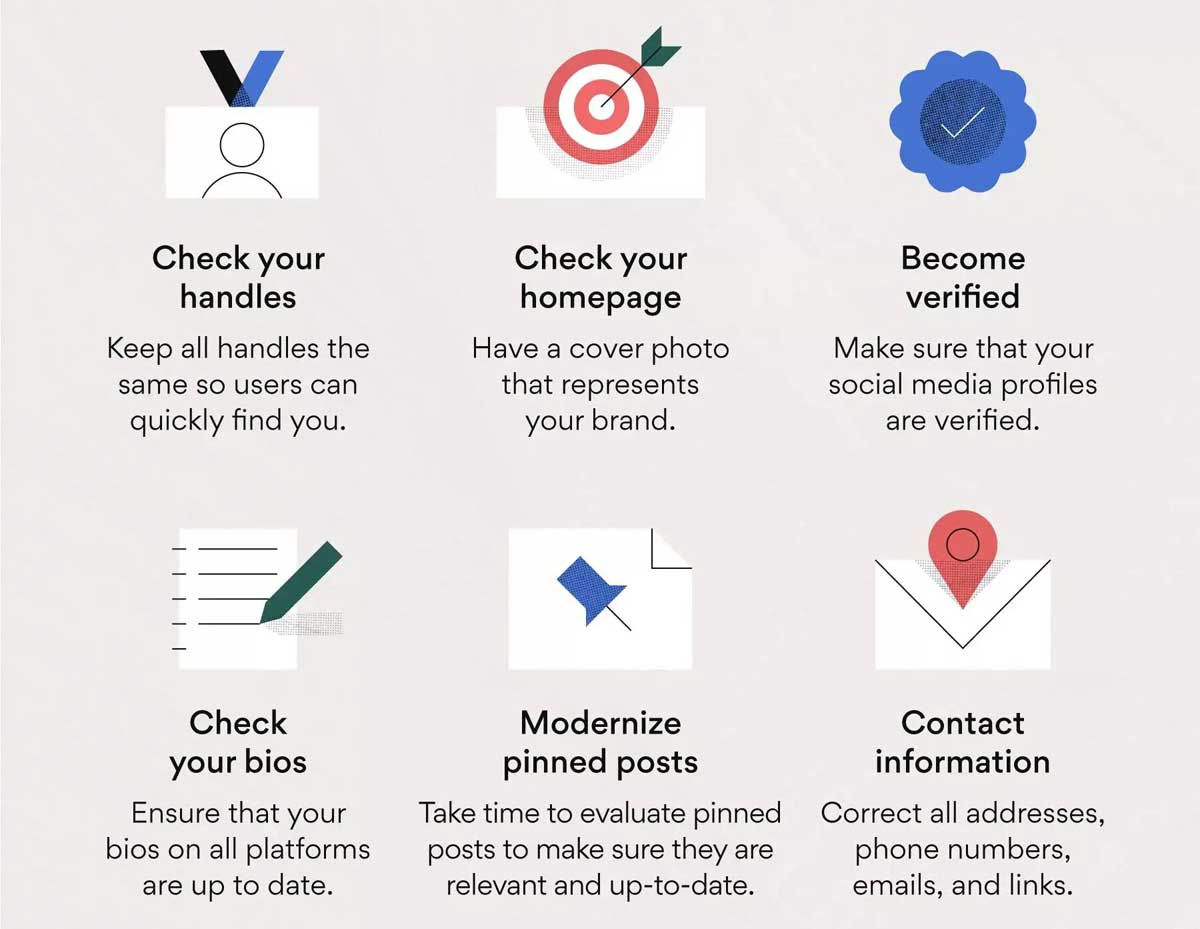
Does your profile make sense to someone who is checking out your company information? To help guide you, consider the following tips:
- Check your handles: As a good rule of thumb, it’s best to keep all of your social media handles the same so users can quickly find you. Consider using your brand name to make it easy.
- Examine the homepage: You’ll want to have a cover photo that is indicative of your brand on the social media account homepage. Make sure the image you choose is properly sized and formatted for that specific social platform.
- Become verified: Consider following the necessary steps to get your social media account verified with a checkmark badge to prove your authenticity. Check with each platform on how to attain this important checkmark.
- Look over your bios: Ensure that your bios on all platforms are up-to-date and accurately reflect your brand messaging and vision statement.
- Update contact information: Use this time to check and correct all addresses, phone numbers, emails, and URLs.
- Modernize pinned posts: Take time to evaluate pinned posts to make sure they are relevant and up-to-date with your current marketing strategy and specific campaigns.
3. Find patterns within your social media profiles
It’s important to understand what posts work for your target audiences on each platform. After all, each social media platform is different, and you need to be aware of what works and what doesn’t.
During your audit, review the engagement rate of your most recent posts across each platform. Do you get more likes, retweets, and shares on videos or photos? Does one kind of post do really well with audiences on Facebook, whereas the same post doesn’t do so well on Instagram? Things to review include:
- Total number of followers
- Likes
- Tweets to your brand
- Retweets
- Shares
- Comments
- Best-performing posts
Add this information to your social media audit template, including any theories and tests you may conduct between now and the next audit. This will help solidify and define your social media strategy going forward, making it easier to make better connections.
4. Set goals and KPIs
Once you’ve identified your profiles and found the patterns of what works and what doesn’t, the next step is to create goals and key performance indicators (KPIs) for each of your profiles. Not every profile needs to have the same goal—it’s best to designate different objectives that best match the consumers on each site.
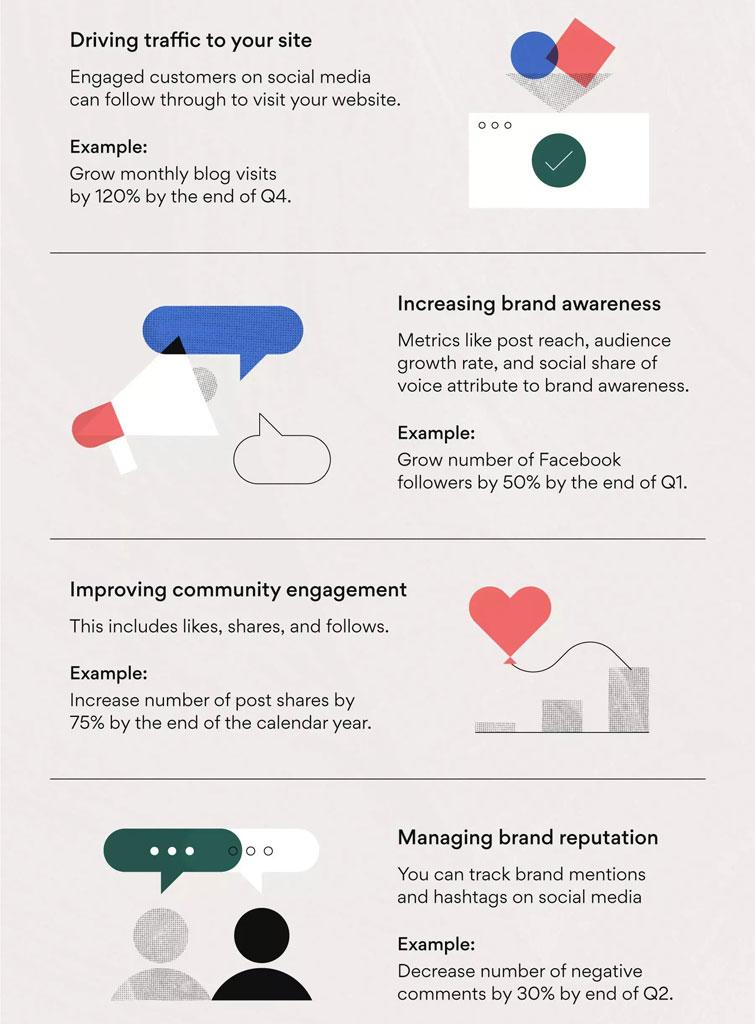
Goals can include:
- Increasing traffic to your site: Engaged customers on social media can follow through to visit your website and increase your unique visits.
- Growing brand awareness: Metrics like post reach, audience growth rate, and social share of voice attribute to brand awareness, which gets customers talking about your brand.
- Managing brand reputation: You can track brand mentions and hashtags, both positive and negative, on social media. This is a great way to get ahead of any potential issues.
- Expanding community engagement: This includes growing likes, shares, and follows. Increased reach means that there are more potential customers hearing about your brand, therefore growing your brand’s awareness.
- Make sure that each goal is SMART: specific, measurable, attainable, relevant, and time-bound. SMART goals set a clear objective, making them more achievable than a generic goal.
5. Assess the best social media platforms for you
Once you’ve gathered information about your social media channels, you can take time to make strategic decisions about where to focus your efforts. Consider your goals set for each social media account and ask yourself the following questions:
- Are your goals being met?
- Could they be better met on a different platform?
- Is there a better platform for one type of content to thrive on?
- Do your customers exist on a platform that you’re not on yet?
Right now, you might have a lot of social platforms without a lot of engagement. Oftentimes, it’s more valuable to put your energy towards a limited number of platforms that are more appropriate for your brand. “Appropriateness” varies, but basically, it means either your customers use that platform, your customers are more likely to engage with your content on that platform, or something else beneficial towards your topline social media goals. Consider using the data you gathered to help decide where your content has the best chance to thrive.
This is also the perfect opportunity to consider deactivating old accounts that haven’t been updated in quite some time since they most likely are not serving any goal-oriented purpose for your company.
6. Standardize channel ownership
While filling out your template, take the time to dedicate one person (or team) to be the social media account “owners.” This person makes sure that each account is up-to-date, on-brand, and reaches the right audience. Designating one person to be in charge of all social platforms means you won’t need to worry about granting access every time you add someone new to the team. Furthermore, this feature enhances the security of your accounts by restricting access to authorized individuals.
7. Track action items and next steps
Once you’ve pulled apart all of this information, the final step in the process is to devise a plan for the future. Running social media audits quarterly gives you plenty of action items to focus on between now and the next audit. For instance:
- Consider keeping your social media strategy the same if engagement is high.
- Think about updating brand strategies where needed.
- Deactivate and delete accounts that are outdated or replaced by newer accounts.
- Change up types of posts if you’re getting little to no engagement on them.
- Post more of the social media content that is garnering high engagement.
- Post more of the types of top-performing posts on a more frequent basis by setting up a social media content calendar.
By devising a specific plan based on the goals that you established above, you can make headway on creating a social media strategy that works best for you and your company. It might take time to notice a difference, so it’s important to keep track of your audits regularly.
Social media audit template
Using a social media audit template offers several key benefits to streamline your auditing process and enhance your social media marketing:
- Organization: A template provides a structured framework to systematically collect and analyze social data from all your social media posts in one centralized place. This keeps the audit organized and ensures you don’t overlook any important social media metrics or social networks.
- Efficiency: Having a predefined social media template saves time and effort compared to starting from scratch. You can jump right into the audit rather than spend time deciding what social data to include and how to format it.
- Consistency: Using the same template each time ensures you evaluate your social media presence consistently across audits. This makes it easier to benchmark your progress over time and identify trends.
- Clarity: Visualizing all the key metrics and KPIs in a side-by-side overview paints a clear, holistic picture of your social media performance. This makes both drawing audience insights and making data-driven decisions for optimizing your strategy easier.
- Collaboration: Templates make it simple to share social media reports with team members and stakeholders. Everyone can get on the same page about goals, priorities, and action items.
The social media audit template included below, will guide you step-by-step to evaluate your social media activity. Simply follow along and input your information to discover the audience insights you need to power your social media marketing strategy.
Social media audit examples
To illustrate what an in-depth social media audit looks like in practice, let’s walk through a few hypothetical examples. These samples showcase how different companies might complete an audit template to assess their online presence and social media rankings.
Example 1: Startup Software Company
This fast-growing startup is using social media marketing to build brand awareness and engage their target audience of small business owners. Their audit reveals:
- Steady follower count growth of 20% per quarter across all social channels
- Highest engagement metrics on educational LinkedIn posts about digital marketing tips
- Lower than average click-through rates and conversions on Facebook ads promoting sign-ups
Based on these insights, the company plans to double down on LinkedIn content and reassess their Facebook ad targeting to optimize performance.
Example 2: Eco-Friendly Clothing Brand
This sustainable fashion brand focuses on Instagram and Pinterest to showcase their products and build a community of eco-conscious shoppers. Key findings from their audit include:
- User-generated content in social media posts receives 5x higher engagement than branded posts
- Styling tips and outfit inspiration pins drive the most referral traffic
- Inconsistent posting cadence on Instagram Stories
The brand resolves to share more customer photos, create additional tutorial content, and commit to posting fresh Stories daily to improve their social media presence.
Example 3: Global Software Corporation
This enterprise software provider maintains an active online presence across all major social networks to engage IT decision makers.
Their audit uncovers:
- Minimal engagement on Twitter, with an audience that skews much younger than their target buyers
- High view counts on in-depth product demo videos
- Extremely active LinkedIn community asking technical support questions
The corporation decides to shift resources away from Twitter to focus on expanding their YouTube library and providing more hands-on support via LinkedIn. They also plan to conduct competitor analysis to benchmark their rivals’ rankings and new platform performance.
Social media audit tools
While you can conduct an audit manually, tools can significantly streamline the process by automating social data collection and providing richer insights. Here are a few types of tools to consider:
1. Social media management platforms
Tools like Hootsuite, Sprout Social, and Agorapulse offer built-in analytics across all the major social networks. You can easily aggregate data on follower count, reach, engagement, top-performing social media posts, and more key metrics. Many also provide reporting capabilities to help visualize trends.
2. Social media analytics dashboards
Platforms like Google Analytics and Adobe Analytics can track social media referral traffic to your website. You can see which networks drive the most clicks, conversions, and revenue, and analyze user behavior after they land on your site. These insights are crucial for optimizing your social media marketing strategy and SEO.
3. Social listening tools
Social listening tools like Mention, Brandwatch, and Talkwalker monitor mentions, keywords, and sentiment across social channels and the wider web. This can provide a broader view of brand perception, share of voice, and audience conversations to complement your analysis of owned social media activity.
Social media audit checklist
To ensure your audit covers all the essential elements, follow this handy social media audit checklist:
- List all your social media profiles, including ones that may be inactive.
- Check each profile for consistent branding, messaging, and up-to-date information.
- Identify your best-performing content types and posting times for each channel.
- Record key metrics like audience growth, reach, engagement rate, and referral traffic.
- Note audience demographic data and any shifts in your follower profile.
- Analyze paid social ads for reach, click-through rates, and conversion rates.
- Review social listening data for brand sentiment and relevant conversations.
- Assess customer service interactions and response times.
- Benchmark your KPIs against industry averages and competitors.
- Summarize key insights, goals, and action items based on the social data to improve your social media performance.
By following this social media audit checklist and leveraging analytics tools, you can gain an in-depth understanding of your social media presence and discover opportunities to optimize your social media marketing strategy.
***
Bring your learnings to life with a social media content calendar
Social media audits don’t need to be scary—they are a necessary part of any digital marketing plan. By taking the time to complete a social media audit template, you can track your progress over time and ensure your efforts are well-spent and making an impact.

 By
By 
















Comments