AI-Assisted Discovery Is Replacing Parts of Search, Not All of It
There has been a shift in how Search is evaluated. Buyers now use AI to compress early-stage research into fewer steps, reducing the number of sites they need to visit before forming an opinion.
That shift is already being reflected in industry forecasts. Gartner predicted that search engine volume will drop 25% by 2026 due to AI chatbots and other virtual agents. For businesses, that is a visibility warning: fewer traditional searches means fewer chances to “win the click” unless you are also showing up inside the answer.
Buyers now typically use AI to:
- Define the problem and options
- Compare vendors and approaches
- Identify red flags
- Build a shortlist before they ever click through
That changes how leads show up. Instead of browsing multiple sites, many buyers arrive with a pre-built opinion, a narrowed list and more specific questions.
Your site has to do two jobs at once:
- Support traditional organic acquisition
- Support AI-assisted discovery that happens before the click
If you rely on content volume and generic service pages, you will feel this change first in lead quality. You may still get traffic, but you will get less consideration. This is the new practical goal of AI-led SEO lead generation: earn inclusion upstream so the right prospects enter your funnel downstream.
Why Being Recommended Now Matters as Much as Ranking
Rankings measure one surface area: where you appear in a list of links. AI discovery introduces another surface area: whether your brand becomes part of the answer.
Operationally, that creates three implications.
1. Your Site May Be Evaluated Without a Visit
Assistants often summarize providers based on what they can extract from public pages. If your content is unclear or unsupported, you lose the chance to be included.
2. Proof Has to Travel
Assistants prefer claims that can be restated with low risk, which means your proof needs to be easy to find and easy to interpret: processes, constraints, outcomes, case studies.
3. Conversion Performance Still Decides Return on Investment
When AI sends fewer but higher-intent visits, every session matters. That is where conversion rate optimization becomes a visibility partner. This is also why many brands are consolidating SEO and content into one operating system; search engine optimization services that feed a content program designed to win both rankings and recommendation surfaces.
How AI Assistants Choose What to Cite and Recommend
You cannot control how every model reasons, but you can control the inputs you publish. In practice, assistants tend to reward sites that reduce ambiguity.
Most recommendations cluster around four signals:
- Extractability: Can the system quickly pull a clean answer?
- Consistency: Does your site say the same thing everywhere or contradict itself?
- Entity clarity: Is it obvious who you are, what you do, where you operate and what category you belong to?
- Trust evidence: Do you show real proof, not slogans?
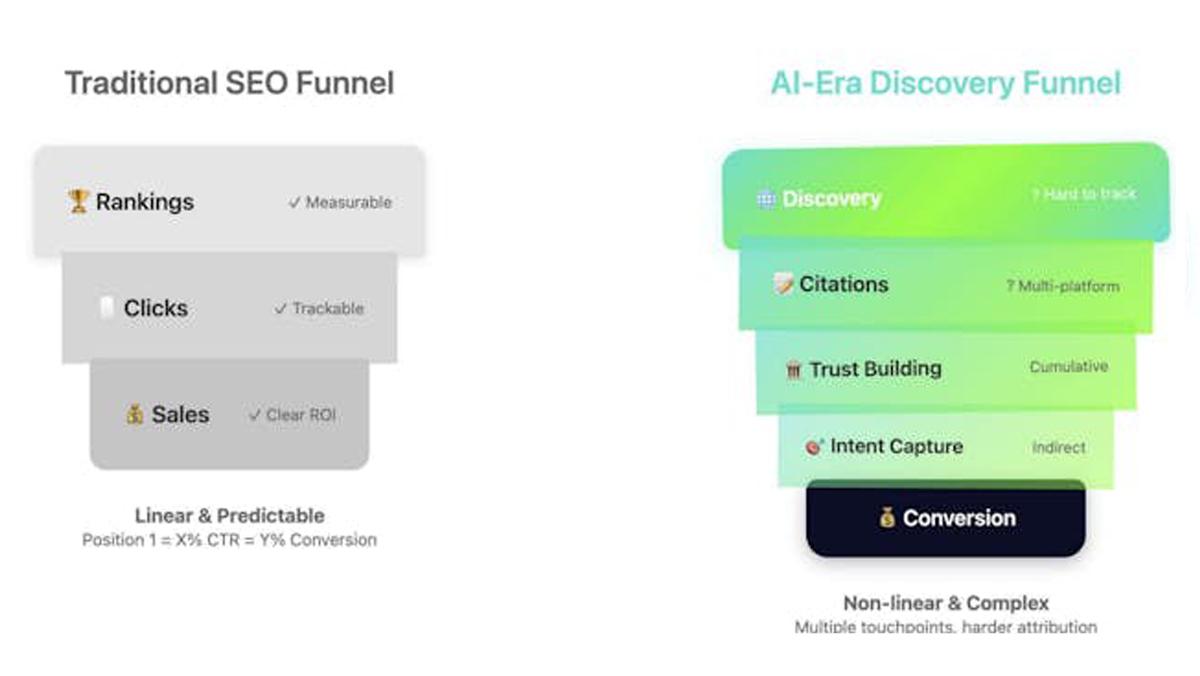
That is the foundation of AI discoverability. It is about building pages that read like operational documentation, not marketing fog. “AI discovery compresses the funnel. If your site does not state who you help, what you deliver and why you’re credible in a format assistants can extract, you will not be recommended consistently,” said Jimi Gibson, Vice President at Thrive Internet Marketing Agency.
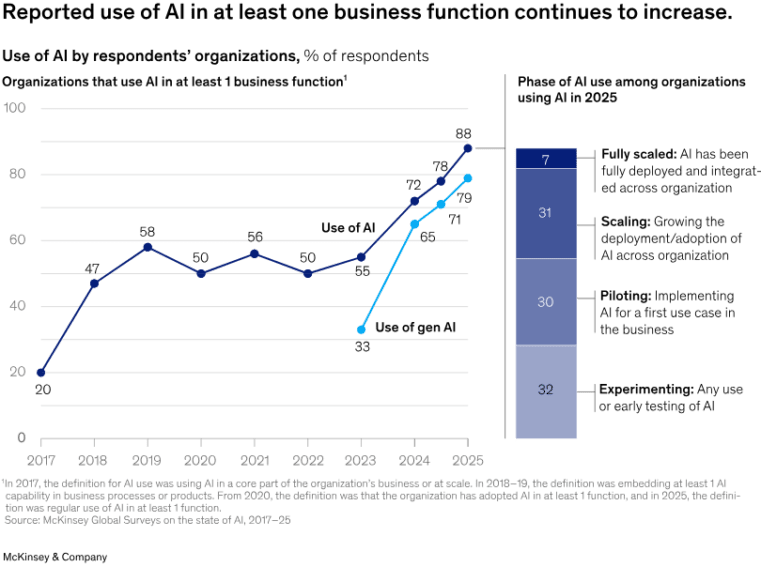
Source: The state of AI in 2025: Agents, innovation, and transformation
There is also a second reason this matters: AI-driven behavior is not a niche edge case anymore. McKinsey reports that 88% of organizations regularly use AI in at least one business function, up from 78% the prior year. As adoption becomes routine, more buyers will use assistants by default, not as an experiment.
6 GEO Fundamentals That Improve AI Visibility
If you want to win assistant-led discovery, you need to build for extraction and verification. The following fundamentals are the highest-leverage place to start:
1. Content Structure for AI Extraction
Even before the adoption of AI, writing best practice dictated that the copy needs to provide clear, immediate answers to user query, instead of vague, dawdling adjectives. Now, this best practice rings especially true.
Publishing rules that improve extraction:
- Lead with a 1 to 2-sentence direct answer, then expand.
- Use descriptive subheads that match real questions.
- Put criteria, steps and requirements into bullets.
- Add constraints so your advice cannot be misapplied.
This is also where you stop writing “blog posts” and start writing “answer assets.”
2. Topical Authority Beyond Keywords
Keyword coverage is table stakes. Authority comes from covering the full evaluation path, including what most competitors avoid.
Authority-building page types:
- “How it works” pages that outline the process, deliverables and timelines
- “Who it is for” and “who it is not for” sections on service pages
- Industry use cases with constraints and decision criteria
- Case-study-driven proof pages that show outcomes and context
This is where content marketing services and writing services can drive more than traffic. They can drive citation-ready clarity.
3. Optimize for Conversational Queries
If you want assistants to choose your content, you need to mirror the way buyers ask questions in real life. To optimize the website for AI search, publish content that answers queries like:
- “What is the best approach for X if we have Y constraint?”
- “What should we do first if performance dropped?”
- “How long will results take, and what affects timeline?”
What works in practice:
- Decision trees and selection criteria
- Short “best for” recommendations with supporting rationale
- Explicit trade-offs instead of generic benefits
4. Strengthen Entity Signals Across Your Site
Entities are how systems reduce confusion. Your job is to remove inconsistencies that create uncertainty.
Entity checklist:
- Standardize service naming across navigation, H2s and internal links
- Publish credible leadership and author bios
- Align About, services and proof pages so they reinforce one narrative
- Keep location and service-area info consistent if relevant
5. Publish Answer-Ready Content That Can Be Quoted
Assistants cite content that is ready to reuse. That means you need pages built for summary, not just scanning.
Answer-ready assets:
- Pricing guidance (ranges, what changes price, what is included)
- Implementation timelines and what happens in the first 30 to 60 days
- Comparisons (“in-house vs agency,” “SEO vs. PPC”) with decision criteria
- “How we work” pages that describe the system, not just the outcome
This is where answer engine optimization (AEO) stops being a theory and becomes a production standard: Write so the answer can be lifted without losing accuracy. If you are using AI to support execution, tie that capability to a clear platform narrative, so assistants and buyers can understand what it is and what it does.
6. Maintain Strong Technical SEO Foundations
Assistants depend on access. If your site has crawl issues, duplication problems or unstable performance, your content becomes harder to retrieve and riskier to cite.
Technical priorities that protect visibility:
- Indexation and crawl hygiene
- Strong internal linking and clean architecture
- Performance and template stability
- Duplication control and canonical discipline
This is where AI search optimization gets real. If systems cannot reliably fetch your best pages, your messaging does not matter. For teams that need help building the technical base and the AI-era content system together, AI SEO services closes that gap.
A 30-Day Implementation Plan
Here’s a roadmap to guide your next steps:
Week 1: Build your “assistant readiness” map
• List the top 10 revenue-driving pages
• Document the top 25 buyer questions sales receive
• Identify missing proof, unclear scope and weak structure
Week 2: Add extractable answer modules
• Add direct-answer blocks to top service pages
• Add decision criteria and “best for” recommendations
• Publish 5 to 10 tight Frequently Asked Questions (FAQs) tied to money pages
Week 3: Fix entity consistency
• Standardize service names and definitions
• Strengthen bios, About content and proof linking
• Remove contradictory claims across pages
Week 4: Lock technical reliability and conversions
• Resolve crawl, duplication and performance issues
• Tighten conversion paths and contact options
• Add real-time engagement that supports lead capture, such as a live web chat
This is the execution layer of generative engine optimization: publish answers, align entities, prove trust, protect access.
5 Common Mistakes That Reduce Discovery and Lead Quality
Most visibility losses in AI discovery are self-inflicted. The patterns are consistent.
- Publishing content that sounds helpful but avoids specifics
- Making claims without proof, then expecting assistants to trust them
- Inconsistent service naming across pages, which creates extraction errors
- Burying the “who we help” and “what we deliver” details under generic copy
- Treating AI lead generation SEO like a content volume play instead of a proof system
A common failure mode is thinking that more pages equals more chances to rank. In AI discovery, more pages can create more contradictions. That weakens AI discoverability because assistants see inconsistent signals and default to safer sources.

 By
By 














Comments