A Good, Effective Headline Is Important
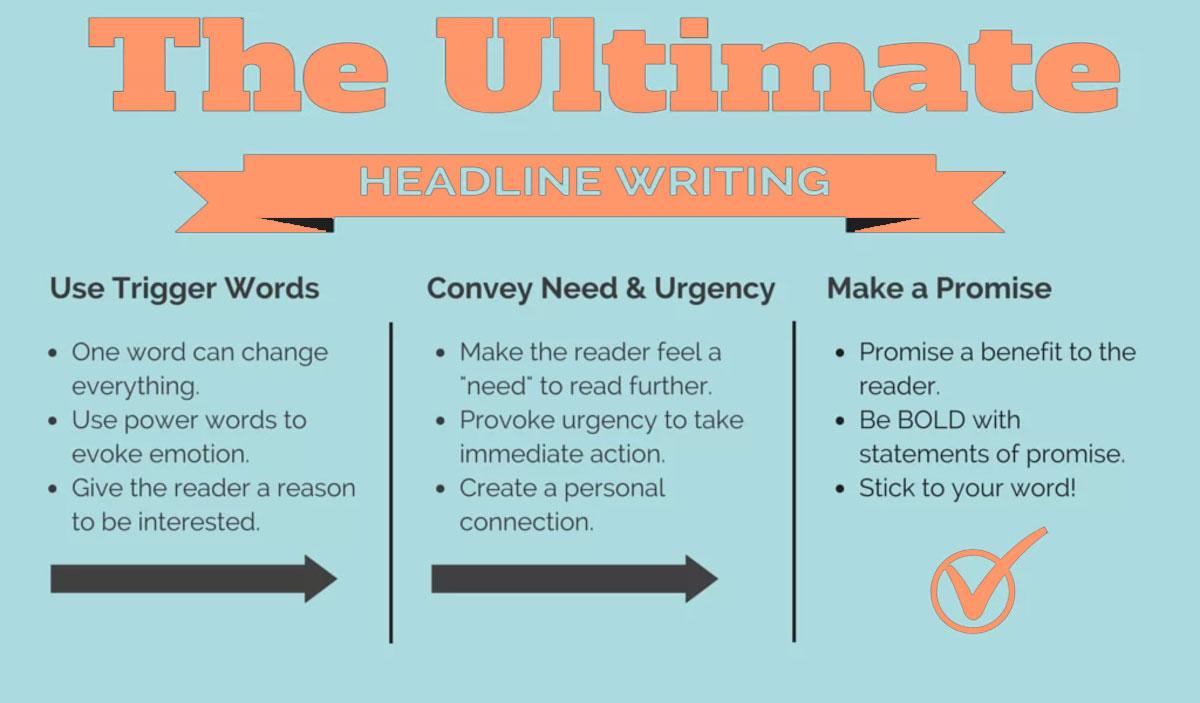
In the whirlwind of content swirling about the internet, you have a split second to convince people your content is worth clicking. And the way you convince them is through your headline. Because we’re exposed to more than 200 headlines every single day, our brains have come up with a rapid-fire way to gauge which are worth clicking.
It uses the cost/benefit ratio: Will the cost of the time spent clicking the headline for more info be outweighed by the benefit we think we’ll gain?
- If the answer is yes, we click.
- If the answer is no, we move on to the other 199+ headlines out there waiting for us.
You want people’s brains to answer an automatic yes. When yes is the answer, you’ll get a boost in content performance across the board, as a bounty of content performance statistics is either directly or indirectly affected by headlines.
Five Components of a Powerful Headline
When readers skim in seconds, only headlines that clearly communicate outcomes and relevance convert attention into results.
Element 1: A Clear Business Outcome
When a headline focuses on topics instead of benefits, it forces the reader to do the mental work of figuring out why the content matters. Most busy readers won’t do that work; they will simply move on. High-performing headlines remove that friction. They immediately signal the business outcome the reader can expect.
This distinction matters because B2B decision makers don’t read content for inspiration. They read it to solve problems tied to measurable goals. When scanning headlines, they are asking:
- Will this help grow revenue?
- Will this reduce risk or cost?
- Will this improve efficiency or decision-making?
- Will this support a strategic initiative already on my plate?
Headlines that answer those questions earn attention. Headlines that don’t are filtered out, even if the content itself is strong.
Examples:
Topic-led (weak) headlines:
- Cloud Computing Trends for 2026
- Understanding AI in Financial Services
Outcome-led (strong) headlines:
- Five Cloud Computing Trends Reducing Infrastructure Costs in 2026
- How Financial Services Use AI to Cut Fraud Losses and Review Time
Element 2: Clarity That Attracts the Right Audience
Headlines that are broad or generic may attract clicks, but they often pull in readers with no buying authority, no urgency, or no relevance to the offer. The result is high traffic but low-quality leads that stall or never convert.
According to branding expert Lene Saile, when an audience doesn’t understand a brand, they are unlikely to trust it and make a purchase. Strong headlines use specificity as a filter. Instead of appealing to everyone, they deliberately narrow the audience. This often reduces total clicks, but dramatically improves lead quality, engagement depth, and downstream conversion rates.
Specific headlines clearly signal who the content is for, the context in which the insight applies, and the outcome it delivers.
Examples:
Define the audience:
- How CMOs Can Improve B2B Marketing Performance Without Increasing Spend
- What Entrepreneurs Need to Know About Seed Funding in a Lackluster Market
Add context:
- Reducing Cybersecurity Risks During Cloud Migration for Financial Services Firms
- How Mid-Market Firms Can Reduce Risk During M&A Integration
Add measurable results:
- How B2B Teams Use AI to Cut Content Production Time by 30%
- How Legal Teams Reduced Review Cycles by 40% Using AI Tools
Element 3: Credible Curiosity
Overly safe headlines blend into the noise. On the other hand, overly clever or exaggerated headlines may earn clicks, but at the cost of trust. The difference lies in how curiosity is created. In the B2B environment, it doesn’t come from hype or emotional triggers. It comes from a new perspective, unexpected insight, and clear relevance. Plus, they are all expressed in the language the buyer already uses.
Examples:
Contrarian insights:
- Why Most B2B Content Best Practices Don’t Translate to Revenue
- Why Standard Cybersecurity Best Practices Leaves Financial Services Firms Exposed
Unexpected data or observations:
- The One Metric That Predicts B2B Content Performance Better Than Traffic
- The Operational Metric That Predicts Plan Downtime Better Than Maintenance Schedules
Reframing familiar problems:
- Why Most B2B Content Fails Before It’s Even Read
- Why Digital Transformation Fails Before New Systems Go Live
Curiosity fails if the headline sounds like a marketing gimmick. High-performing headlines mirror how buyers talk internally in meetings, frame problems to colleagues, and describe challenges to leadership. If a headline wouldn’t sound natural in a boardroom or strategy discussion, it likely won’t perform.
Element 4: Brevity Built for Busy Decision-Makers
The challenge isn’t just earning attention. It’s earning it quickly. Decision-makers rarely sit down to read content end to end. Instead, they skim inboxes between meetings and scan search results or AI summaries for immediate answers. This is why brevity matters. If a headline takes too long to process, it loses the race for attention.
Concise headlines are easier to scan across crowded channels, communicate value faster, and match how buyers consume information today.
Examples:
Weak headlines:
- How B2B Organizations Can Begin to Rethink and Improve Their Operational Strategy in a Rapidly Changing Market
- A Comprehensive Guide to Improving Cross-Functional Alignment Across the Enterprise
Strong headlines:
- How Manufacturing Leaders Are Rethinking Production Strategy Amid Supply Chain Volatility
- How Clear Processes Reduce Cycle Time in Financial Services Operations
Pro tip: Instead of cramming every detail into the headline, use subheads to carry context, audience specificity, or supporting insight. For example, Why B2B Content Fails Before It’s Read: How Headlines Determine Visibility, Clicks, and Trust. This approach keeps the headline scannable while still setting accurate expectations.
Element 5: Keywords Without Sacrificing Readability
Even strong insights lose value if they can’t be found. High-performing headlines balance search intent with clarity. They align with how buyers seek out solutions, without sounding like keyword lists written for algorithms. When done well, SEO-friendly headlines extend the lifespan of content, turning a one-time publish into a long-term asset.
Examples:
Weak headlines:
- Optimizing Content Synergy Across the Funnel
- Enterprise Knowledge Management Frameworks
Strong headlines:
- How B2B Teams Align Content Across the Funnel
- How Enterprise Teams Manage Knowledge Without Slowing Work
Before publishing, pressure-test the headline. Is the core keyword naturally embedded, without disrupting clarity? Would the headline still make sense to a human reader without any context? Does the wording reflect how a buyer would phrase the problem in search? If the headline reads well out loud and aligns with buyer intent, it’s likely optimized enough.
In Brief…FAQs
Why do headlines matter so much in B2B content performance?
- In B2B, headlines act as the first qualification filter. They determine whether the right decision-makers click, engage, and trust the content. Weak headlines reduce visibility across search, email, and AI-driven discovery, which limits pipeline impact before the content is ever read.
What makes a headline “high-performing” in B2B markets?
- High-performing B2B headlines clearly signal a business outcome, define the intended audience, and create credible curiosity without hype. They balance clarity, brevity, and search intent so buyers immediately understand why the content is relevant to their goals.
How can marketers balance SEO keywords with headline readability?
- The most effective headlines embed keywords naturally, using the same language buyers use when searching for solutions. If a headline reads clearly out loud and still reflects real search intent, it’s likely optimized without sacrificing trust or comprehension.

 By
By 

















Comments